
How to Build a Profitable Fractional Consulting Business Without the Firm Chaos (One Consultant's 7-Month Journey)
Prefer to listen while commuting or preparing dinner? Click here and get access to the Fracture podcast feed. Pause if you need to (or listen at 2x speed) and get all the details/advice that don’t make it to the blog posts.
Why ditching firm life for fractional work gave Abbie more money, better clients, and time to finish her novel
Abbie Fine spent 10 years as a frontline fundraiser burning out in small nonprofits. Then five more years at a consulting firm where she couldn't choose her clients and had way too many of them.
Seven months into running her own fractional business? She's working with two organizations she actually chose, making more money than she ever did at the firm, and finally has time to finish her 95,000-word manuscript.
If you're a nonprofit consultant wondering whether you can actually build a sustainable business without the chaos, or if you're stuck at a firm questioning whether there's a better way, this is for you.
THE CONSULTING FIRM TRAP THAT KEEPS GOOD CONSULTANTS STUCK
Here's what Abbie experienced at her firm (and what I hear from consultants constantly):
"I can't choose who I work with."
"I have too many clients to do meaningful work with any of them."
"There's no space left for the things that actually matter to me."
Abbie loved getting to dig into different nonprofit organizations and engage with other fundraisers. But she didn't get to choose her clients. And she had a lot of them.
When she heard about the fractional model, where she could work with clients she actually wanted to work with and have greater impact without the stress of being an ED or director, something clicked.
She joined the Nonprofit Fractional Operating System last February. Ten months later, she's been running her fractional business for seven months.
And here's what changed.
WHAT ACTUALLY HAPPENS WHEN YOU GO FROM FIRM LIFE TO FRACTIONAL
THE REALITY CHECK: You don't have to trade chaos for entrepreneurial hustle.
When Abbie made the leap, she discovered something most consultants don't realize until they try it: the fractional model lets you make more money with fewer clients while actually having time for the things that matter.
Even with only two fractional clients, Abbie's making more than she did as a consultant with a firm. And more than she made as a frontline fundraiser.
This isn't about working more hours or hustling harder. It's about positioning yourself properly and charging what you're actually worth.
HER CLIENTS ARE GETTING REAL RESULTS
One of Abbie's clients had never attempted a year-end campaign before. They thought it was too crowded, that people wouldn't give, that it wasn't worth trying.
By Giving Tuesday? They were already at 90% of their goal.
Her other client said it's been "so much easier this time" and they're performing better than in previous years.
That's the difference between being spread across a dozen clients and being able to focus on two organizations where you can actually move the needle.
SHE'S FINALLY MAKING PROGRESS ON HER CREATIVE WORK
Abbie's also a fiction writer. Before going fractional, finding time to write felt impossible between the chaos of nonprofit work and the volume of consulting firm clients.
In one year of fractional work, she's made more progress on her manuscript than she did in previous years of traditional employment. That 95,000-word novel? It's making the rounds to friends and editors.
When you build a business that actually serves your life instead of consuming it, this is what becomes possible.
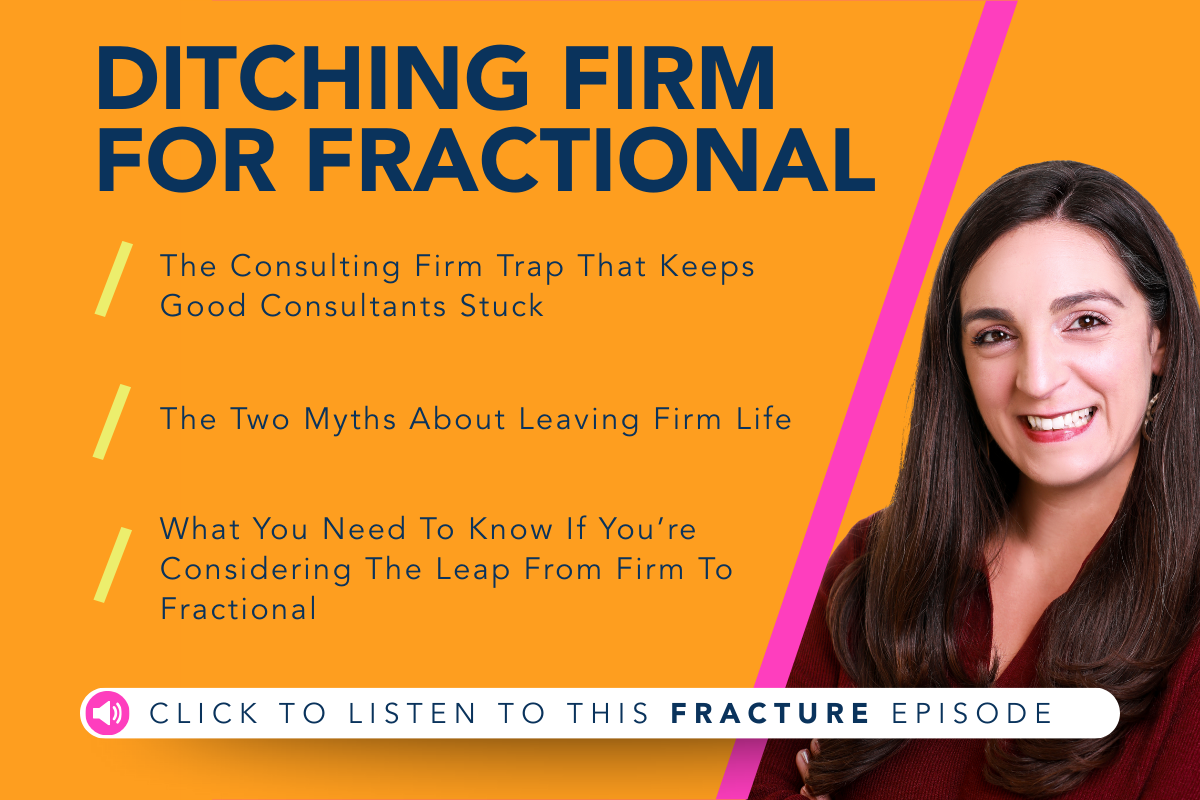
Click on the image to hear Abbie break down the consulting firm trap, the myths that keep good consultants stuck, and what really matters if you’re thinking about leaving firm life for fractional work.
THE HARD LESSONS FRACTIONALS LEARN (THAT FIRM CONSULTANTS DON'T HAVE TO FACE)
Going fractional isn't all smooth sailing. Abbie learned some tough lessons in her first seven months, lessons that firm consultants never have to navigate because someone else handles client selection and capacity management.
LESSON #1: FRACTIONAL ISN'T FOR EVERY ORGANIZATION (AND THAT'S OKAY)
Abbie's first fractional client? She let them go this fall.
Not because she didn't know what she was doing. Not because she failed. Because the fit wasn't right.
The executive director basically wanted someone to delegate to. They weren't looking for a strategic partner; they wanted staff without the HR headaches.
That's not what fractional is. And Abbie had to get comfortable saying, "This isn't the best fit for me OR for this organization."
Here's what made that decision even harder: she was friends with this person beforehand. The money was sure. And Abbie's a high achiever who doesn't like to fail.
But she chose to prioritize her other clients, her own well-being, and the kind of work she actually wanted to do.
The nonprofit now has someone on staff who's a better fit for what they need. Abbie has capacity for clients where she can make real impact. Everyone wins.
LESSON #2: NAVIGATING MULTIPLE PROSPECTS WHEN YOU ONLY HAVE ONE SPOT IS HARD
At one point, Abbie was talking seriously with two potential clients. One had been in conversation for months, cordial, productive, but slow decision-making (because nonprofits…). The other moved quickly and was ready to commit.
Both organizations were exciting. Both groups of people were great. But one was only committing to 2-3 months to build a fundraising plan before renewing. The other was committing to 12 months.
Abbie had to navigate this dance without either:
a) Taking on too many clients and sacrificing the whole reason she went fractional (balance, time for writing, time for her kids)
b) Losing both opportunities by hemming and hawing too long
She chose the client with the 12-month commitment and more financial security.
But here's the thing firm consultants don't face: that little ego boost of being wanted by multiple organizations at once can make you question your own boundaries. The temptation to say yes to everything, to prove you're successful, to secure more money, to feel in-demand, is real.
Abbie knew her whole point of doing this work was to have balance. Taking on four clients toward year-end would have destroyed that.
LESSON #3: YOU HAVE TO OWN YOUR OWN EXPERTISE (EVEN WHEN IMPOSTER SYNDROME SHOWS UP)
When one of Abbie's clients got a really large surprise donor, brand new to the organization, her first thought was: "That's a fluke."
Then she caught herself. "Maybe it wasn't completely a fluke. Maybe we did the right things. Maybe I should trust that I'm good at this."
This is the imposter syndrome that shows up for fractionals in a way it doesn't when you're part of a firm. At a firm, there's institutional credibility. When you're on your own, you have to own your results and trust your expertise without that external validation.
Abbie's clients are hitting 90% of their year-end goals. They're saying it's easier and performing better. That's not luck. That's her work.
But she still had to talk herself into believing it.
THE TWO MYTHS ABOUT LEAVING FIRM LIFE THAT KEEP CONSULTANTS STUCK
MYTH #1: YOU WON'T FIND CLIENTS ON YOUR OWN
Abbie was terrified she wouldn't find any clients. That fear is so common - and so understandable.
But here's what surprised her: it happened quickly. Really quickly.
In her early conversations, she thought some people would be referral partners who'd introduce her to potential clients. Two of them said, "No, that's me. This is very compelling. Can you help me?"
She also had conversations that went nowhere. But the speed at which she found the right clients, some of whom she'd worked with before, gave her confidence that this could actually work as a full-time thing.
The fractional model fills a real need. Organizations are hungry for this kind of support. Your network is deeper than you think.
MYTH #2: YOU'LL BE ALONE AND ISOLATED WITHOUT THE FIRM STRUCTURE
One of Abbie's favorite parts of going fractional? The community she's built with other fractionals.
Through the Nonprofit Fractionals Network, she discovered other fractionals in her area and reached out to organize a happy hour. They clicked immediately. Now that DC-area group meets monthly for co-working, hanging out in a coffee shop for four or five hours talking shop, sharing leads, showing each other CRM screens, helping with the nitty gritty day-to-day work.
When someone reaches out about a client in the democracy space (not Abbie's thing), she now has two friends who are great at it and can make referrals. When she needed to think through letting go of that first client, her DC colleagues helped her plan it out.
This isn't competition. It's collaboration. It's support. It's having colleagues again without the firm overhead.
And it makes the work feel fun and collaborative instead of isolating.
WHAT YOU NEED TO KNOW IF YOU'RE CONSIDERING THE LEAP FROM FIRM TO FRACTIONAL
Stop Googling "is fractional consulting sustainable" and ask yourself these questions instead:
DO YOU WANT TO CHOOSE YOUR CLIENTS?
At a firm, someone else decides who you work with. In your own fractional practice, you get to say yes to organizations where you can make real impact, and no to ones that aren't the right fit.
Abbie values this above almost everything else. It's the reason she made the leap.
ARE YOU READY TO OWN YOUR CAPACITY DECISIONS?
Nobody's going to tell you that you're taking on too much. Nobody's going to protect your boundaries for you.
When Abbie was navigating multiple prospects, she had to be the one to say, "Four clients would destroy the balance I'm trying to create." When she needed to let go of a client, she had to be the one to make that call.
That's freedom. But it's also responsibility.
DO YOU HAVE A NETWORK TO ACTIVATE (OR ARE YOU WILLING TO BUILD ONE)?
Abbie's first clients came through her existing network, including people she'd worked with before who immediately saw the value of the fractional model.
You don't need a massive network. But you do need relationships you can activate and a willingness to have conversations.
CAN YOU GET COMFORTABLE WITH THE BUSINESS CYCLE?
Early on, Abbie wasn't confident in the business cycle. She felt like she needed to say yes to every potential client because she wasn't sure where the next contract would come from.
Seven months in? She's more comfortable. But that comfort came from experience, community support, and trusting the model.
THE REAL RISK ISN'T LEAVING THE FIRM
The real risk is staying somewhere that doesn't let you choose your clients, build the life you want, or do your best work.
Abbie came into fractional with privilege she acknowledges, she's in a dual-income household, so the financial pressure wasn't crushing. But even with only two clients, she's making more than she did at the firm.
She's not stressed for the first time ever in December. She's making progress on her creative work. Her clients are hitting their goals.
This didn't happen despite leaving the firm. It happened because of it.
YOUR NEXT MOVE IF YOU'RE STUCK AT A CONSULTING FIRM
Stop waiting for the "perfect" moment to make the leap. Start with where you have traction:
// Look at the clients you've loved working with. What do they have in common?
// Where does your network naturally cluster?
// What kind of work lights you up instead of draining you?
// What would your life look like if you could choose your clients and set your own capacity?
Your fractional business doesn't have to be perfect on day one. But staying stuck at a firm that doesn't serve your life won't get you any closer to the business you actually want.
The freedom to choose your clients, make more money, and have time for what matters? That's not a pipe dream. It's what consultants like Abbie are building every single day.
Ready to build a fractional consulting business that actually works?
// The Nonprofit Fractionals Operating System teaches you how to find the right clients, position yourself with clarity, and build six figures with just three organizations, without the burnout or chaos of firm life. Join the waitlist here.
// In episode 14 of FRACTURE, Marcela Zafra shared how she went from questioning her worth to confidently stating "This is my price, take it or leave it"—proving that confidence comes from doing the work, not from feeling ready. Just like Abbie had to learn to trust that her client's major new donor wasn't a fluke, it was her strategic work paying off.
// P.S. - Want to hear the full conversation with Abbie? Listen to the complete Fracture podcast episode where we dig into the moment she knew it was time to let go of her first client, how her clients went from never attempting year-end to hitting 90% of goal, and why having fewer clients you actually choose beats being overbooked every single time. Listen here → https://nonprofitfractionals.com/fracture
Abbie Fine is the founder of Candle and Mirror Strategies, providing fractional fundraising support to nonprofits. Connect with her on camstrategies.com

READY TO HEAR WHAT NO ONE ELSE IS SAYING?
Subscribe to Fracture. This private podcast is where we talk honestly about what it takes to build a fractional consulting business that pays you well, respects your time, and still lets you care deeply about your work.