
Why Nonprofit Consultants Need Systems + Community (Not Just Templates)
Prefer to listen while commuting or preparing dinner? Click here and get access to the Fracture podcast feed. Pause if you need to (or listen at 2x speed) and get all the details/advice that don’t make it to the blog posts.
You're Googling "consulting contract template" at midnight again.
ChatGPT is open in another tab. You've bookmarked seventeen different blog posts about pricing strategies. Your Downloads folder is a graveyard of free resources you'll "get to eventually."
And you still have no idea what to charge for that proposal sitting in your drafts.
This is how Mandy Moody was building her consulting business before she joined the Nonprofit Fractionals Network. She had landed her first client before the program, which is great, but she was grinding through every single business decision alone.
The irony? She was doing to herself exactly what she tells her nonprofit clients NOT to do: reinventing the wheel, starting from scratch, refusing to lean on experts who've already paved the path.
Sound familiar?
THE IRONY OF DIY CONSULTING
Here's what I see all the time with new consultants.
You spent your entire in-house career advising nonprofits to stop recreating things that already exist. You told them to use proven frameworks. You encouraged them to hire consultants (like you) instead of figuring everything out themselves.
But when it comes to your own business? Suddenly you're out here acting like Google and ChatGPT are going to build you a sustainable consulting practice.
They won't.
Mandy's moment of clarity came when she saw one of my Instagram reels and thought: "Wait a second. I am doing, as a business owner, what I am helping my clients not to do."
She was telling organizations not to reinvent the wheel. Not to start from scratch. Not to rely on free resources when they need real expertise.
But that's exactly how she was approaching her own business.
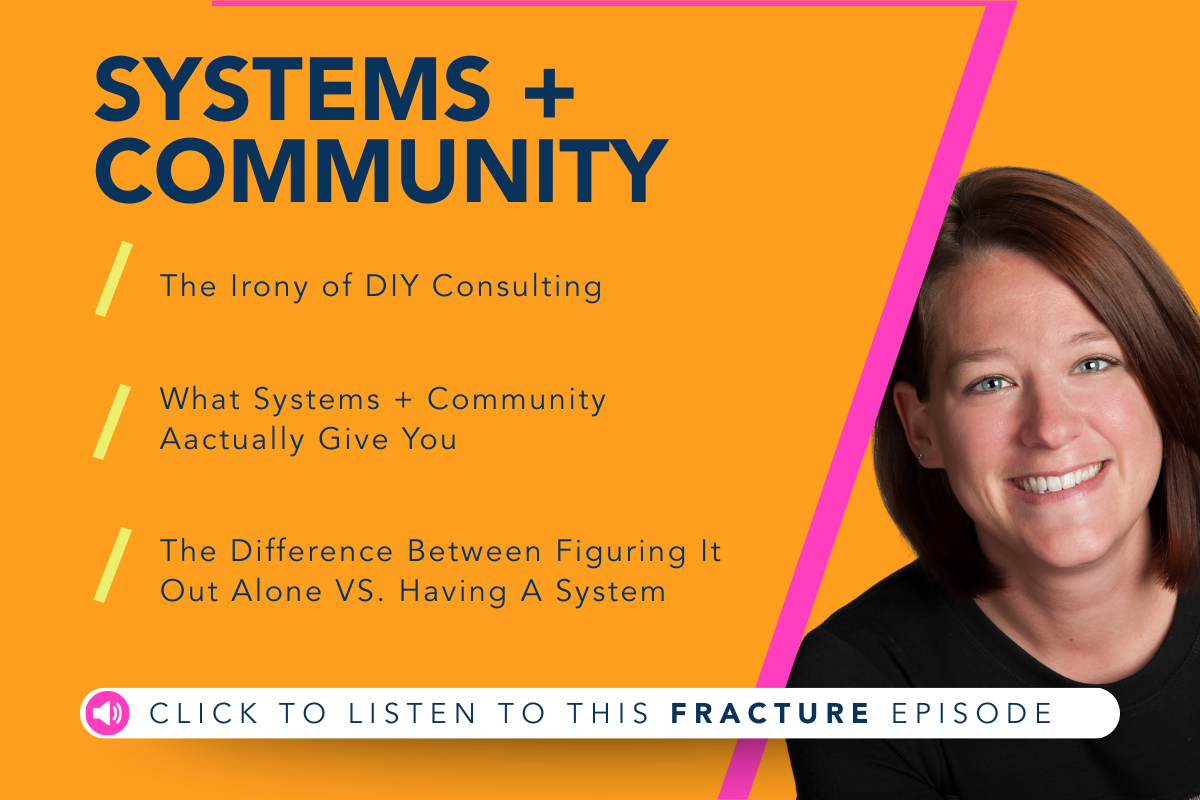
Click on the image to hear Mandy explain how systems and community can simplify your business, help you stop doing everything alone, and give you a real path to grow without burning out.
WHAT SYSTEMS ACTUALLY GIVE YOU
When Mandy joined the OS, she expected templates and resources. Contract templates, proposal generators, pricing guides, the concrete stuff that makes you feel like you're getting your money's worth.
And she got all of that.
But here's what she didn't expect: the systems that would prevent her from overdelivering herself into burnout with her very first client.
MONTHLY SNAPSHOTS AND QUARTERLY REPORTS These aren't just admin tasks. They're your proof that you're delivering value without doing too much. They give you visibility into when you're slipping into over-delivery mode (which we all do). And they give clients clarity so they stop panicking and asking for more.
Without these systems, Mandy was heading into her renewal conversation thinking "I don't know if I've done enough." Then she started filling out the proposal generator and realized: "Wait a second. I've done a LOT. Maybe too much."
That's what systems do. They give you the structure to see what's actually happening in your business, not what anxiety is telling you is happening.
THE SCOPE OF WORK THAT PROTECTS YOU Her first client's scope spanned operations, programs, HR, fundraising, event planning. All the things.
That works when you have one client. It doesn't work when you scale to three.
The OS taught her how to right-size her scope so she could deliver incredible value without recreating the burnout she left behind. How to have renewal conversations that tighten focus instead of expanding scope. How to protect herself from herself.
WHAT COMMUNITY ACTUALLY GIVES YOU
But here's the thing Mandy says she underestimated: the community.
She joined for the education and templates. She's staying for the Slack channel and office hours.
THE SLACK CHANNEL THAT ACTUALLY RESPONDS Most online communities are graveyards. You post a question and get crickets. Or you join a Facebook group with 10,000 members where your question gets buried in thirty seconds.
The NFN Slack is different. It's active. People actually show up. You can ask "how did you handle this client situation" and get real answers from people who've been there.
Mandy called it out specifically on our podcast: "I've joined other LinkedIn groups and Facebook groups, and I've been really happy with how active it is because I know folks have joined things before and it's crickets."
OFFICE HOURS WHERE YOU ACTUALLY GET TO TALK We had office hours the morning Mandy and I recorded this episode. She was workshopping her renewal conversation in real time with eight other people who've all been through it.
That's the kind of support you can't get from a Google search or a ChatGPT prompt. You need people who understand the specific dynamics of nonprofit consulting - the guilt, the scope creep, the fear of saying no.
And you need a group small enough that you actually get to talk. Not a hundred-person Zoom where you're never getting off mute.
THE REAL DIFFERENCE BETWEEN FIGURING IT OUT ALONE VS. HAVING A SYSTEM
Mandy said something that really stuck with me: "I feel like I'm not just an idea bank of one."
That's the shift.
When you're building alone, every decision feels massive. Every pricing conversation feels like you're making it up. Every scope creep situation feels like maybe you're the problem.
But when you have systems and community, you're not making it up anymore. You're following a proven process. You're learning from people who've already made (and recovered from) the mistakes you're about to make.
YOU DON'T HAVE TO GOOGLE EVERYTHING AT MIDNIGHT The OS gives you the frameworks for Client Flow (how to find and close clients) and Work Flow (how to manage fractional work without burning out). Those aren't just buzzwords. They're the two core skills that determine whether your business works or doesn't.
You don't need to piece together advice from seventeen different blog posts. You need one system that actually works for nonprofit fractional consultants specifically.
YOU DON'T HAVE TO MAKE BUSINESS DECISIONS IN A VACUUM When Mandy was preparing for her renewal conversation, she didn't have to guess what to do. She used the proposal generator. She brought questions to office hours. She got feedback from people who'd already renewed their first clients.
That's the difference between DIY and having actual support.
THE BOTTOM LINE
You can keep Googling. You can keep downloading free resources you'll never use. You can keep asking ChatGPT to solve problems it doesn't understand.
Or you can work with people who've actually built nonprofit fractional businesses and lived to tell about it.
Mandy joined thinking she'd get templates. She got a whole business instead, one that's now at full capacity with retainer clients, projecting to exceed her old in-house salary.
The templates are great. The systems are essential. But the community? That's what keeps you from making expensive mistakes alone at 2am.
And honestly, that's worth more than any contract template you'll ever download.
READY TO STOP GOOGLING EVERYTHING?
// The Nonprofit Fractionals Operating System teaches you the two skills that actually matter: how to get clients (Client Flow) and how to manage the work without burning out (Work Flow). Plus, you get the community that keeps you from doing this alone.
// In episode 13 of FRACTURE, Laurie De Fleuriot shares how she scaled from solo consultant to six-person team, and how the community transformed her business from isolated trial-and-error to supported growth. If you're wondering what's possible when you stop building alone, that episode shows you exactly what happens when you have the right people in your corner.
P.S. Want to hear the full conversation with Mandy about what actually changes when you stop building alone? Listen to the complete Fracture podcast episode here where we talk about systems, community, and why your first client is actually your business school.

READY TO HEAR WHAT NO ONE ELSE IS SAYING?
Subscribe to Fracture. This private podcast is where we talk honestly about what it takes to build a fractional consulting business that pays you well, respects your time, and still lets you care deeply about your work.