
How to Scale a Fractional Consulting Business While Building a Tech Company (One Consultant's Ambitious Journey)
Prefer to listen while commuting or preparing dinner? Click here and get access to the Fracture podcast feed. Pause if you need to (or listen at 2x speed) and get all the details/advice that don’t make it to the blog posts.
Why using fractional consulting as your financial foundation might be exactly what you need to pursue that bigger idea you keep putting off
Fractional consulting doesn't have to be your endgame.
For some people, three clients and balance is the dream. That's what I envisioned when we built this model.
But for others? Fractional becomes the financial foundation that lets you build something bigger.
Janine Ayoub is one of those people. She started as a first-time consultant three years ago. She'd spent most of her career in-house and was traveling between countries as a digital nomad when she saw my LinkedIn post calling for consultants.
She didn't know what fractional was. She took on two clients to figure things out.
Now? She runs a six-person team doing fractional work AND she's building a tech platform that actually bridges the gap between nonprofit programs and fundraising—a problem the sector desperately needs solved.
If you're multi-passionate and wondering how to pursue bigger ideas without abandoning fractional work, this is for you.
THE TWO TYPES OF FRACTIONAL CONSULTANTS
I see two types of people come into the Nonprofit Fractionals Network.
The first want two or three clients and they're good. They want to do good work, get in and out of organizations, and have other things in their lives.
The second are like, "I'm not gonna stop there. I'm gonna do all this crazy stuff."
Janine's squarely in that second category.
Neither is better. But you need to know which one you are.
Because if you're multi-passionate and you want to pursue bigger ideas, fractional can fund that. But you need to be honest about whether you're willing to do the work to make both things happen.
HOW TO MANAGE MULTIPLE VENTURES WITHOUT BURNING OUT
Let's be real: you can't do everything at once.
Building a tech company while running fractional clients is no joke. I spent a morning this week building an AI workflow for myself - just a simple tool where I can send myself a voice memo and have AI turn it into a draft email. Everyone talks about how the barriers to entry are so low with AI.
But I kept getting errors. It sounds straightforward, but it's still quite technical.
Janine's doing that times a thousand. And she's figured out that if you want to run fractional clients AND build something bigger, you need to figure out your own time management system.
JANINE'S THEME DAY STRATEGY (AND WHY IT WORKS FOR HER)
Here's how Janine structures her week to manage fractional clients plus building a tech company:
One day for company work (team meetings, setting weekly schedules)
One brutal client-facing day (all meetings in one day - exhausting, but then it's done)
Two focus days for client work (divided into timed blocks, one task per block)
One day for wrap-up and planning next week
I batch my meeting days and non-meeting days too, but everyone manages their time differently. The key is finding what works for you and actually sticking to it.
For Janine, theme days are how she protects deep work time while keeping clients happy. For you, it might look completely different.
WHY YOU NEED A TEAM YOU CAN TRUST
Janine currently has two fractional clients. She has two team members who help with grant writing, copywriting, research, and tasks.
But she's the person who is client-facing, who reviews everything, who makes sure the quality is very good before delivering to the client.
After almost 17 years in the sector, she's now "allowed" to do this - commenting on documents, rewriting - instead of writing everything from scratch.
Her other team members include a graphic designer, video editor, social media person, and a web developer who's helping develop websites for clients.
Part of their work is for clients. Part of their work is for the company itself. They're all over the world, in different time zones. Communication happens at weird times.
But growing all of this in two or three years? One person couldn't do this alone.
If you want to scale beyond solo consulting, you need to let go of some control and trust other people to do good work.
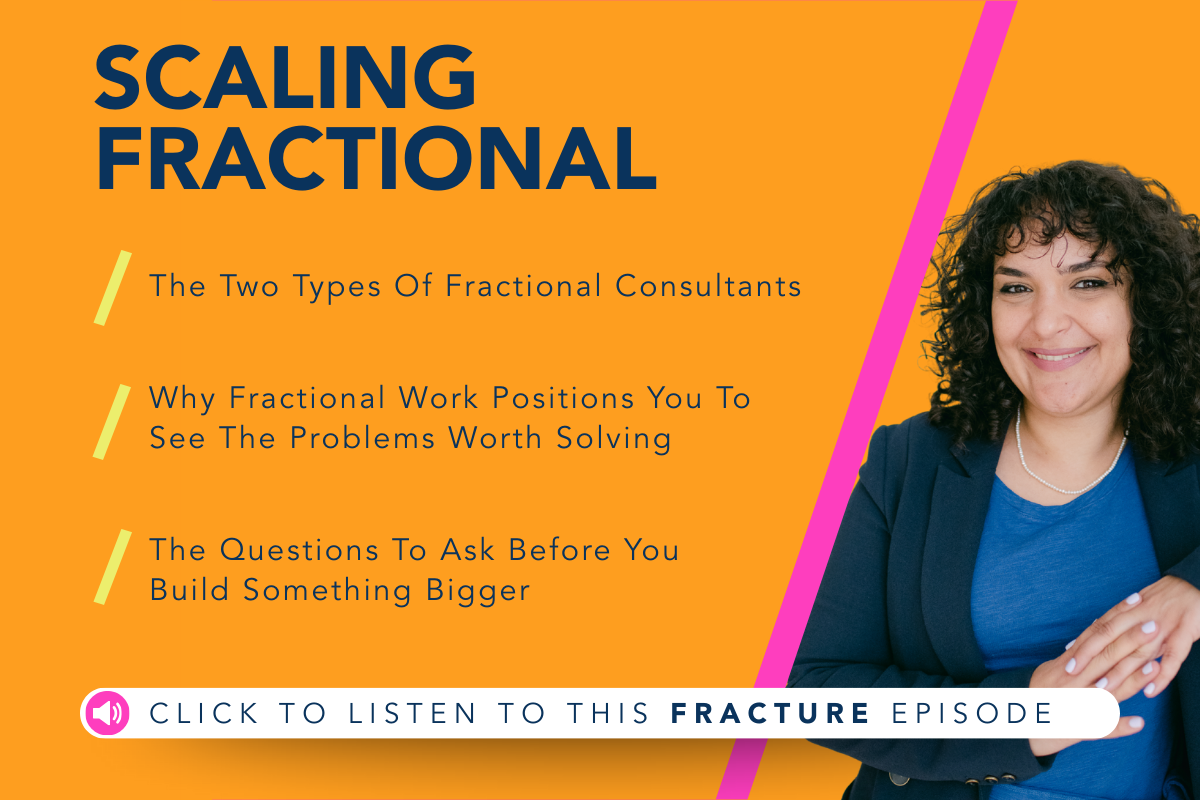
Click on the image to hear Janine share how to scale your fractional consulting business, build a team you trust, and use fractional work as the foundation for something even bigger.
THE QUESTIONS TO ASK BEFORE YOU BUILD SOMETHING BIGGER
Stop Googling "how to scale a fractional business" and get honest with yourself:
IS FRACTIONAL YOUR ENDGAME OR YOUR FOUNDATION?
If you're content with three clients and balance, that's perfect. Don't feel pressure to do more.
But if you're multi-passionate and you have bigger ideas, fractional can fund them. You just need to be strategic about it.
CAN YOU RUTHLESSLY PROTECT YOUR TIME?
Theme days. Boundaries. Saying no to scope creep.
If you're not willing to get disciplined about your schedule, whatever that looks like for you, you'll burn out trying to do multiple things.
DO YOU HAVE A PROBLEM YOU'RE UNIQUELY POSITIONED TO SOLVE?
Your combination of experience positions you to see problems nobody else sees. Janine's programming + fundraising background let her spot the silo problem that her platform now solves.
What do you see in your fractional work that others miss? And are you willing to invest time, energy, and resources to build the solution?
WHY FRACTIONAL WORKS AS A FOUNDATION FOR BIGGER THINGS
Here's what makes fractional consulting perfect as a financial foundation if you want to build something bigger:
You can build to six figures with just three clients. That's predictable revenue without needing 20 contracts.
You control your time. With the right systems and boundaries, you can dedicate part of your week to fractional work and part to your bigger project.
You're building expertise that informs your next thing. The problems you see doing fractional work might be exactly what you're positioned to solve.
THE REAL RISK ISN'T STAYING SMALL
The real risk is not pursuing the thing you're uniquely positioned to build because you're afraid it's too ambitious or too hard.
Janine started as a first-time consultant three years ago. She took on two clients to figure things out while traveling between countries.
Now she's managing fractional clients, running a six-person team, learning tech jargon and cap tables, preparing for investor pitches, and building a platform that could change how nonprofits connect programs to fundraising.
That didn't happen by accident. It happened because she was willing to use fractional as a foundation and build something bigger on top of it.
The freedom to pursue ambitious ideas while maintaining fractional clients? That's not a pipe dream.
But it requires ruthless time management, a team you trust, and the willingness to stay present in multiple worlds at once.
YOUR NEXT MOVE IF YOU'RE MULTI-PASSIONATE
Stop waiting for the "perfect" moment to pursue that bigger idea. Start with where you have traction:
// What problem do you see in your fractional work that nobody else is solving?
// What's your unique combination of experience that positions you to build the solution?
// Can you structure your time so part goes to fractional and part to your bigger project?
// Are you willing to build a team and let go of some control?
// What would your business look like in three years if you started today?
Your fractional business doesn't have to be the endgame. It can be the foundation that funds the bigger thing you're building.
The question is: what are you building on top of your fractional foundation?
Ready to build a fractional consulting business that works as your foundation?
// The Nonprofit Fractionals Operating System teaches you how to find clients, position yourself with clarity, and build six figures with just three clients - giving you the financial stability to pursue whatever comes next. Join the waitlist here.
// In episode 5 of FRACTURE, we talked about why boundaries are your secret weapon as a fractional executive. If you're building something bigger on top of your fractional work, boundaries aren't optional—they're how you protect the time and energy to actually make it happen. Read more about boundaries as a business tool here.
// P.S. - Want to hear the full conversation with Janine Ayoub? She breaks down her theme day strategy, what "play" actually means in business, how she manages a team across time zones, and why she's building tech that bridges nonprofit silos. Listen here
Janine Ayoub is the founder of Yamm Services, providing fractional fundraising and program support to nonprofits. Connect with her at yammservices.com

READY TO HEAR WHAT NO ONE ELSE IS SAYING?
Subscribe to Fracture. This private podcast is where we talk honestly about what it takes to build a fractional consulting business that pays you well, respects your time, and still lets you care deeply about your work.