
Should You Subcontract for Another Consulting Firm? The Honest Answer About Rates, Control, and What Actually Works
Prefer to listen while commuting or preparing dinner? Click here and get access to the Fracture podcast feed. Pause if you need to (or listen at 2x speed) and get all the details/advice that don’t make it to the blog posts.
Why some fractional consultants thrive as subcontractors while others should never even try - and how to know which one you are
Ginny Waller runs a consulting firm with a team of senior and associate advisors who work as subcontractors. She's also been a subcontractor herself.
She hated it.
Turns out, not everyone is built for subcontracting - whether you're the one hiring subs or becoming one. And the sooner you figure out which side of that line you're on, the better off you'll be.
Ginny started Waller Consulting nine years ago, focusing on leadership transitions and strategic planning for nonprofits. She's scaled by building a network of experienced subcontractors who get her signature frameworks, all the templates and materials, and steady client work without having to do their own business development.
But here's what she learned after trying subcontracting herself and building a team of subs: if you need to control every question in the focus group, if you resist someone checking in on your progress, or if you can't let go of decision-making authority, subcontracting will make you miserable.
THE SUBCONTRACTOR PERSONALITY TEST NOBODY TALKS ABOUT
Subcontracting is not for everyone. And that's completely okay.
Ginny figured this out the hard way. She tried subcontracting three times. She enjoyed exactly zero of them.
Why? Because she likes being her own boss.
She doesn't want someone else determining what the focus group questions should be. She doesn't want to follow a framework she didn't create. And she definitely doesn't want anyone checking in asking "where are we on part three?"
That's not a character flaw. That's self-awareness.
THE PEOPLE WHO SHOULD NEVER SUBCONTRACT
If you're the type of person who really needs to be determining the strategy, who wants to shift the structure because you don't like doing it that way (not because it's an informed decision, just because), or who doesn't want someone managing your timeline and deliverables, then subcontracting isn't for you.
And honestly? That's most of us who've built our own consulting businesses in the first place.
We left institutional jobs specifically because we wanted autonomy. We went fractional because we wanted to choose our clients and run things our way.
Asking someone like that to subcontract is like asking a cat to act like a dog. Sure, technically both are pets. But the fundamental nature is different.
THE PEOPLE WHO THRIVE AS SUBCONTRACTORS
But there's another personality type. The fractionals who love getting their hands dirty doing good work but don't want all the heavy lifting that comes with running a business.
These are the people who:
// Want to work in a team environment and miss having colleagues to strategize with
// Are comfortable releasing some authority and decision-making for the benefit of not doing business development
// Don't need to reinvent the wheel on every project and are happy to use proven frameworks
// Value having someone else handle the sales conversations and client recruitment
If that's you, subcontracting might actually be your perfect fit.
The key is knowing which one you are before you commit.
WHAT IT ACTUALLY LOOKS LIKE TO BUILD A SUBCONTRACTOR NETWORK
Ginny's built a team of subcontractors who work on leadership transitions, strategic planning, fundraising, HR, and board training. She's not running a membership. She's not charging them fees to be on a referral list.
She brings them in to do work with her clients. Period.
But building this kind of team required getting clear on some non-negotiables.
HOW GINNY VETS SUBCONTRACTORS
Two years ago, if you'd asked Ginny how she vets subcontractors, she wouldn't have had a good answer.
Now? She's narrowed it down to something deceptively simple: values alignment.
She doesn't do long interview processes. She has conversations to understand if the consultant aligns with how her business operates.
Her business is built around being willing to say the hard things. That's what drives change. Not everyone is comfortable with that kind of conflict.
So she needs to know: Are you the type of subcontractor who's going to go really hard and die on that hill if you have to? Because that's what we're selling to the client. That's who they're going to get.
If you're not that person, they don't get what they're supposed to get.
She's also looking for:
// Transparency and full authenticity about what you can and can't do
// Solutions-focused thinking, not bringing more problems to the client's feet
// Responsiveness and showing up when asked
// The ability to bring hard truths with a little bit of laughter and keep everyone comfortable
Her brand is "sassy southern." If you can't deliver difficult feedback with warmth and a slight edge, you're not going to be a good fit.
This isn't about skills. It's about whether you can operate the way her business operates.
THE FRAMEWORKS AND MATERIALS THAT MAKE SUBCONTRACTING ACTUALLY WORK
Here's what Ginny does that makes subcontracting attractive to the right people: she gives them everything.
She has two signature frameworks. Upshift for leadership transitions. Pivot Point Strategy for strategic planning.
When a subcontractor works with her, they get the full framework, all the materials, the PowerPoints (or Canva decks, in this case), the focus group documents, the templates, everything.
There's no creating from scratch. There's no "we have to update our language." There's no duplicating work that's already been done.
This is what Waller Consulting thinks strategic planning looks like. The subcontractor brings their expertise in navigating hard conversations, facilitating interviews, and being a thought partner with the client.
They don't have to be the administrative person. They get to be the strategic person.
That saves a massive amount of time. And anyone who's run their own consulting business knows how valuable that is.
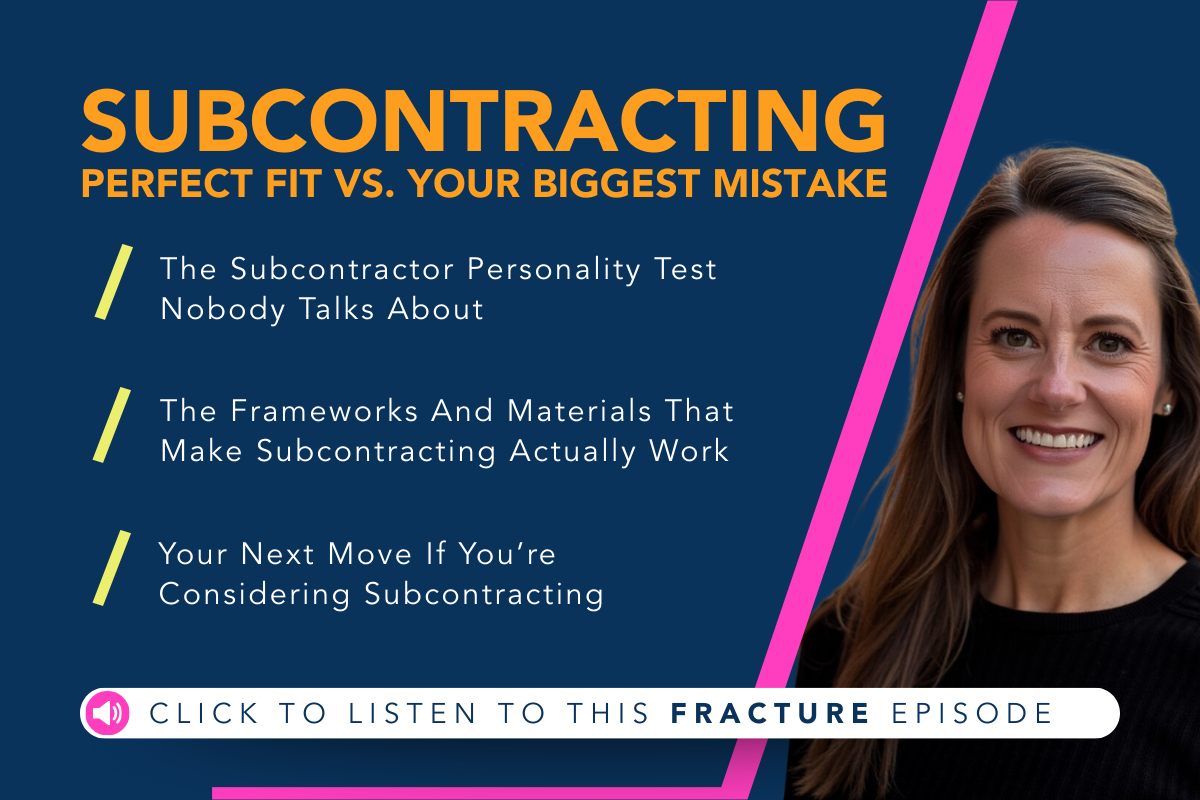
Click on the image to hear Ginny break down when subcontracting is a smart move, when it’s a terrible fit, and how to know which side of that line you’re really on.
THE SUBCONTRACTOR PRICING CONVERSATION NOBODY WANTS TO HAVE
Let's talk about money. Because this is where a lot of subcontracting arrangements fall apart.
Ginny's philosophy on pricing has evolved. Two or three years ago, she had a different approach. She'd ask subcontractors what they wanted to make off an engagement, and that's what she'd pay them.
Sounds great in theory. In practice, it left almost no profit margin for her business and created misalignment when client budgets didn't match what the subcontractor wanted.
HOW SHE HANDLES PRICING NOW
Here's how it works now:
Ginny does all the business development. She recruits the client, does the sales conversations, negotiates the contract. Once the contract is signed, she approaches the subcontractor.
"This is what I was able to negotiate for our contract. I believe this is the window for your flat rate or hourly rate. If that works for you, let's move forward. If it doesn't, I'll put you on a different project."
She works all over the United States. A contract in Mississippi is going to have a different budget than a contract on the West Coast. The subcontractors need to be just as fluid as she is in their rates.
But you as a subcontractor need to know your bottom line. You need to know what you need to make for your business to work and for you to feel like you're getting paid what you're worth.
Because if you don't, you're going to become resentful. And resentment kills good work.
THE PROFIT MARGIN REALITY
If you're thinking about bringing on subcontractors, you need to be realistic about profit margins.
When you're paying someone their full rate and you're doing all the business development, client management, and systems work, your margin is going to be slimmer than if you were just doing the work yourself.
That's the trade-off for scale.
But if you structure it right, with clear frameworks and efficient systems, it can work. You're building a business, not just trading hours for dollars.
THE HARD QUESTIONS TO ASK YOURSELF BEFORE YOU SUBCONTRACT (FOR ANYONE ELSE OR WITH YOUR OWN BUSINESS)
Whether you're considering becoming a subcontractor or bringing them on, you need to get honest with yourself first.
IF YOU'RE CONSIDERING SUBCONTRACTING FOR ANOTHER FIRM
DO YOU ACTUALLY WANT SOMEONE ELSE CALLING THE SHOTS?
Be honest. Can you follow someone else's framework without needing to "improve" it? Can you accept check-ins on your progress without bristling? Can you let someone else determine the strategic direction?
If the answer is no, don't do it. You'll be miserable, the client won't get the experience they were promised, and you'll damage your relationship with the firm you're working with.
CAN YOU SET YOUR RATES SO YOU WON'T BE RESENTFUL?
You need to know your number. What do you actually need to make this worth it?
If you're doing it because you need another contract and you're willing to take less than you should, you're setting yourself up to resent the work, the firm, and yourself.
Don't subcontract because you need a job. Subcontract because it's a great fit for you to work in a team environment and not have to do your own business development.
ARE YOU DOING IT FOR THE RIGHT REASONS?
The right reasons: You want to focus on doing good work without the business development lift. You miss working in a team. You value proven frameworks and systems. You want steady work while building your own client base on the side.
The wrong reasons: You're desperate for income. You think it'll be easier than finding your own clients. You're avoiding learning how to do business development.
When you do it for the wrong reasons, you're going to resent it. And everyone loses.
IF YOU'RE CONSIDERING BRINGING ON SUBCONTRACTORS
ARE YOU READY TO LET GO OF CONTROL?
If you need every deliverable to be exactly how you would've done it, you're not ready to bring on subs.
You need to trust that someone with their own expertise and style can deliver great work within your framework, even if it's not exactly how you would've approached it.
CAN YOU CREATE SYSTEMS THAT MAKE IT EASY FOR THEM TO SUCCEED?
Ginny gives her subs everything. Frameworks, templates, materials, all of it.
If you're expecting subcontractors to figure everything out on their own while you keep all the intellectual property locked up, it's not going to work. They'll spend all their time on admin instead of being strategic thought partners for clients.
DO YOU HAVE ENOUGH WORK TO MAKE IT WORTH IT?
Don't bring on subcontractors because you think it'll help you scale someday. Bring them on when you already have more client work than you can handle yourself.
Otherwise you're creating overhead with no revenue to support it.
THE BUSINESS MODELS GINNY SAID NO TO (AND WHAT SHE CHOSE INSTEAD)
Ginny's seen a lot of different business models in the consulting space. Some work. Some don't. Some are straight-up exploitative.
THE MODELS SHE AVOIDED
THE PAY-TO-PLAY REFERRAL MODEL: You pay a fee to be on a referral list. Then you pay again if you actually get placed with a client. The business makes money by collecting fees from as many consultants as possible, not by actually getting them work.
Ginny belongs to one network like this (the Interim Executive Network out of DC), and it's the only one because the return is worth it. But she's tried others where the return was extremely low.
When a business is making its money by charging consultants instead of serving clients, the motivation is to get more consultants, not to place the ones they have. That's backwards.
THE PERCENTAGE-BASED REVENUE SHARE MODEL: Some consulting groups require you to pay a regular overhead fee plus a percentage of your revenue. But you're also required to have your own clients (otherwise you'd be an employee).
So you're paying to be part of the group, giving them a cut of your revenue, and still doing your own business development. What exactly are you getting in return?
WHAT SHE BUILT INSTEAD
Ginny's model is simple: Her job is to serve clients. Subcontractors are part of that equation, not the revenue model itself.
She doesn't charge subs fees to be on her team. She brings them in when they're the right fit for a specific client engagement.
She does ask subs to contribute content - coffee conversations for her podcast, articles for the resource page, social media posts. But she promotes their businesses while she does it.
It's not a membership. It's not a referral network. It's a consulting firm that uses subcontractors strategically to serve clients well.
And the subs benefit from frameworks, materials, steady work, and a community of other nonprofit consultants to strategize with.
THE COMMUNITY PIECE NOBODY TALKS ABOUT (BUT IT MATTERS MORE THAN YOU THINK)
Here's something Ginny's built that goes beyond just bringing subs in for client work: a community.
Her associate advisors get together for meetings. They did a cybersecurity webinar. They strategize together about the complex client situations they're navigating.
When you're working with nonprofits in crisis, when you're coming in during leadership transitions or organizational messes, you need people to process with. You need to check your own ego. You need thought partners who understand the work.
That's what fractionals miss most when they leave institutional jobs. The team. The colleagues. The people who get it.
If you're going to build a subcontractor model, the community piece is what makes people want to stay. It's what makes them feel like they're part of something bigger than just getting occasional contract work.
YOUR NEXT MOVE IF YOU'RE CONSIDERING SUBCONTRACTING (IN ANY DIRECTION)
Stop Googling "should I subcontract as a fractional consultant" and ask yourself the hard questions instead.
IF YOU'RE CONSIDERING BECOMING A SUBCONTRACTOR:
// Can you actually follow someone else's framework without needing to change it?
// Do you know your financial bottom line and can you stick to it?
// Are you doing this because it's a good fit or because you're desperate for work?
// Do you genuinely want to focus on doing good work without the business development lift?
IF YOU'RE CONSIDERING BRINGING ON SUBCONTRACTORS:
// Do you have enough client work right now to justify bringing someone else in?
// Can you create frameworks and systems that make it easy for subs to do great work?
// Are you ready to let go of control and trust other people's expertise?
// Can you vet for values alignment instead of just skills?
The fractional model is flexible enough to work a lot of different ways. Subcontracting is one of them.
But it only works when you're honest about what you need, what you're willing to give up, and whether you're built for it in the first place.
Ginny figured out she wasn't built to be a subcontractor. But she was built to create a business where the right subcontractors could thrive.
The question is: which side of that equation are you on?
Ready to build a fractional consulting business that works for you - whether that's solo, with subcontractors, or as a subcontractor yourself?
// The Nonprofit Fractionals Operating System teaches you how to position yourself with clarity, set sustainable rates, and build six figures with just three clients. Join the waitlist here.
// In episode 15 of FRACTURE, we talked about how every boundary violation in your consulting business is on you, not your clients. Whether you're subcontracting or hiring subs, those same boundaries apply—you need to know what you're willing to give up and what you're not. Read more about handling scope creep and setting sustainable boundaries here.
// P.S. - Want to hear the full conversation with Ginny Waller? Listen to the complete Fracture podcast episode where we dig into how she vets subcontractors based on values, the pricing model that actually works, and why some personalities should never subcontract. Listen here
Ginny Waller is the founder of Waller Consulting, providing leadership transition support and strategic planning to nonprofits. Connect with her at capacitytodream.com

READY TO HEAR WHAT NO ONE ELSE IS SAYING?
Subscribe to Fracture. This private podcast is where we talk honestly about what it takes to build a fractional consulting business that pays you well, respects your time, and still lets you care deeply about your work.