
How to Build a Sustainable Fractional Consulting Business: From Hourly Hustle to Predictable Pipeline
Prefer to listen while commuting or preparing dinner? Click here and get access to the Fracture podcast feed. Pause if you need to (or listen at 2x speed) and get all the details/advice that don’t make it to the blog posts.
Why having fundraising expertise doesn't mean you know how to run a business—and what changes when you learn the skills you're missing
Shonet Newton had clients before she joined the Fractional Fundraiser Academy (now the Nonprofit Fractional Operating System).
But she was scrambling.
Hourly rates. Month-to-month hustle. No real business model. Just "happy to be happy, let's do whatever works."
She had over 12 years of nonprofit fundraising expertise. But she'd never run a business before.
She didn't know that hourly rates penalize your expertise. She didn't know how to stop scope creep when clients kept adding "just one more thing." She didn't know how to build a pipeline instead of constantly hustling for the next contract.
A year after joining the program, everything shifted.
Now she has more clients, more in the pipeline, and can look ahead through the rest of the year instead of figuring it out month by month. She's networking strategically, setting things up in advance, creating sustainability.
If you're charging hourly and feeling penalized for being good at your work, or if you're scrambling month-to-month with no real pipeline, this is for you.
THE HOURLY RATE TRAP THAT PENALIZES YOUR EXPERTISE
Shonet kicks herself for starting with hourly clients.
"I was just new to the whole thing and so happy to be happy. I was like, yeah, let's do whatever works. Not really having that business acumen."
Here's the problem with hourly rates: you're penalized for your expertise.
If you can get a job done in a few hours because you're good at it, you're selling yourself short. The value isn't in the hours you spend - it's in the expertise and knowledge that makes you fast and effective.
WHEN CLIENTS DON'T KNOW HOW TO USE YOU
Shonet had another problem with hourly work: some clients had high expectations, while others didn't even know what to do with her.
They were so busy or so lost that they couldn't optimize her as a resource. They'd pay for hours but not get the value because they didn't have the capacity to manage the relationship.
That's the other trap of hourly work - you're dependent on the client's ability to direct you, and if they're overwhelmed (which most small nonprofits are), you both lose.
DON'T RECREATE YOUR NONPROFIT JOB IN YOUR CONSULTING BUSINESS
Shonet's first retainer client started out promising. But pretty quickly, things felt familiar in a bad way.
She was doing more than the scope of work because clients kept asking. Board members were emailing her with their priorities. They wanted one-on-one meetings. They wanted her to work on their fundraising plans.
"It felt like I'm back in the office where everybody's emergency is on me and they want me to do all these things."
THE WAKE-UP CALL
She realized: “I don't want my consulting business to mirror the bad experiences that didn't work when I was in-house. I want the things that worked there to work now.”
So she had a conversation with the executive director and his assistant.
"I said, these are the reasons why I don't think it's working and I'm gonna terminate our contract early."
They were understanding. They knew the dynamics. No hard feelings. She still supports their work, they just don't officially work together.
That's a boundary. And it's a business skill she had to learn.
HOW TO PREVENT SCOPE CREEP FROM DESTROYING YOUR BOUNDARIES
Here's how Shonet prevents scope creep from happening again with other clients:
"I have started being more specific with my scope of work. And when things start to creep, I bring it back to that."
THE SCRIPT THAT WORKS
Whether it's in regular meetings or in an email, she says something like:
"Maybe I think this is a good idea or I don't for the organization, but it's not something I can take on because it's beyond our current scope of work. If you would like me to do that, we can expand it and that will be at a different rate."
She also stopped volunteering herself.
"That's something I've done. I need to not volunteer myself as much."
This is the business skill most consultants struggle with. We're helpers. We want organizations to do well. We want to be proud of our work.
And we often equate that with over-contributing and overworking.
But that's usually not the case. In fact, it has a counter effect where we burn ourselves out.
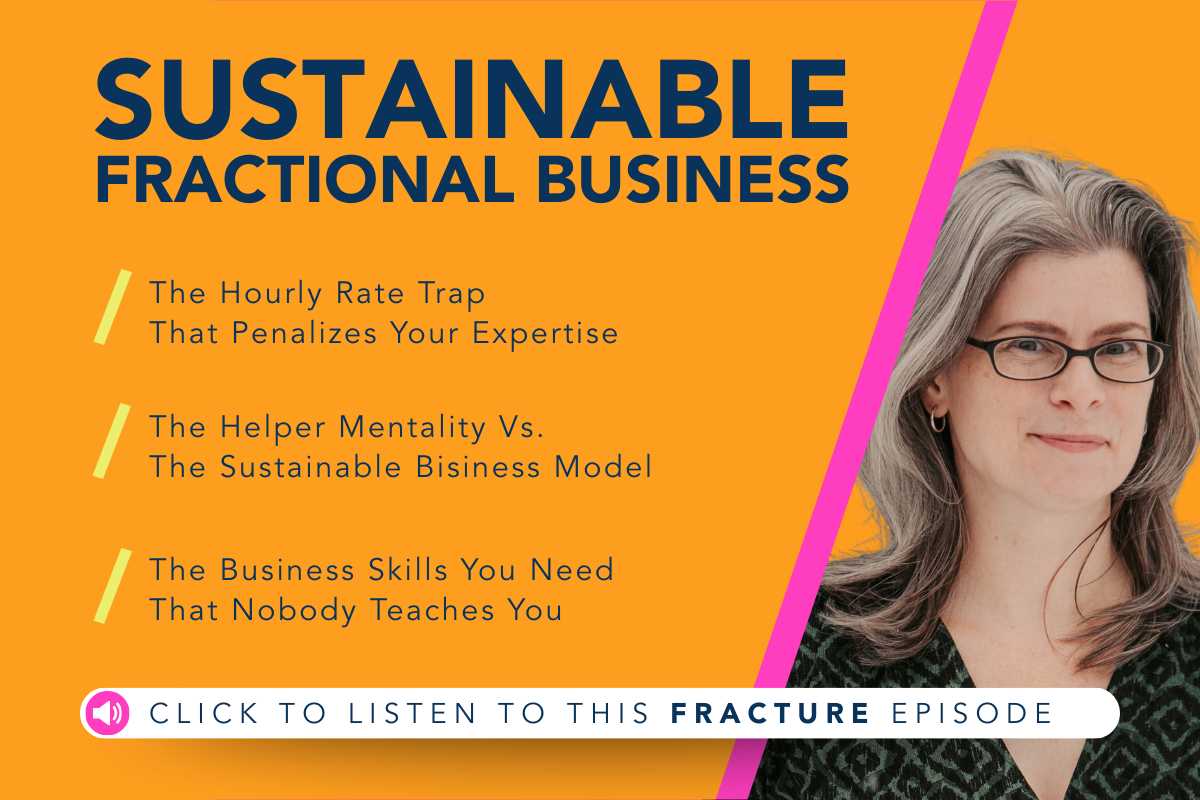
Click on the image to hear Shonet share how to move beyond the hourly rate trap, shift out of the helper mentality, and build a sustainable fractional consulting business.
THE HELPER MENTALITY VS. THE SUSTAINABLE BUSINESS MODEL
Shonet's honest about something a lot of consultants struggle with:
"I struggle with wanting to help organizations, which is why I started my consulting business. If they have a limited budget, I try to find a way to work with them, which sometimes is a great thing and sometimes is not the best business model. Still learning that balance."
This tension is real.
You care about the work. You want to make an impact. You see organizations struggling with capacity and budget.
But running a sustainable business means sometimes saying no to organizations you'd love to help because the model doesn't work.
LEARNING TO FOCUS ON SCOPE
Shonet is learning how to focus on the scope of work and do the best job she can with that.
"And then if we wanna do something else, we can. So it's an ongoing process, but it's getting much better than it was in my first year."
That's the shift. You can still help. You can still make impact. But you do it within boundaries that keep your business sustainable.
BOARDS KILL DEALS (AND HOW TO GET AROUND IT)
Shonet had two recent situations that felt frustrating.
She had wonderful meetings with executive directors. Great rapport. They wanted to work together.
Then the board came back a few weeks later and said: "No, that's not the direction we wanna be taking."
WHY BOARDS DON'T UNDERSTAND FRACTIONAL
Boards often aren't from the nonprofit sector. They don't have a full understanding of what's best for fundraising or what's best for the organization.
"They're looking at it from this governance side. But they're not in it the way that we are."
They lack imagination. They're easily influenced by the models they already know and understand.
Sometimes you get lucky and there's someone on the board who knows fractional executives from the for-profit space. But most of the time, they've never heard of it.
THE SOLUTION: GET IN FRONT OF THE BOARD
If you can present to the board, present to the board.
Shonet started offering that during calls to get things moving.
But there's another strategy: when you were in-house and you wanted board buy-in on something, you'd meet one-on-one with key influencers before presenting to the broader board.
There are usually a couple of people the rest of the board looks to for direction. If you can get them bought in first, the full board conversation goes differently.
It's a complicated dynamic. But if you've spotted it as an issue, you can start playing around with how to navigate it.
FROM MONTH-TO-MONTH SCRAMBLING TO LOOKING A YEAR AHEAD
Let's talk about what Shonet's business looks like now compared to before she joined the program.
Before: A few hourly clients. Figuring it out month by month. Scrappy business model. No real predictability.
Now: More clients. More in the pipeline. She can look ahead through the rest of the year and see when clients might be coming up or when people have let her know they might have work later.
"Not just scrambling as much. I'm networking more, I'm having more connections with people, setting things up in advance so that there's more longer-term progress and sustainability."
WHAT CHANGED
The shift wasn't just about getting more clients. It was about learning the business skills she didn't have.
How to price properly (not hourly). How to set boundaries around scope creep. How to select values-aligned clients. How to build a pipeline instead of constantly hustling.
She went from "happy to be happy, let's do whatever works" to having clear systems and boundaries.
That's what happens when you have the right support and community for your business growth - not just your expertise, but the business model that makes fractional work sustainable.
VALUES-ALIGNED CLIENT SELECTION MATTERS
When it comes to deciding if a client is a good fit, Shonet has three clear criteria:
MISSION ALIGNMENT
"The work that they do has to align with my value system, which carries into my personal and professional life. Those are non-negotiables for me."
She focuses on social impact, environmental justice, gender violence. She has no experience fundraising for arts and education, so she sticks within her fields.
PERSONALITY FIT
"A lot of it depends on that first pre-discovery call in terms of how they wanna work, how they communicate, and just getting a sense of their personality. Can we work well together?"
Because if you can work well together, you can accomplish anything.
"You can have the best mission that aligns with the work that I do, but if our personalities don't mix, we're not gonna get good work done."
This is the beauty of working for yourself. You get to put those parameters out there and choose who you work with.
COMMUNITY BEATS COMPETITION (WHY NETWORKING CHANGED EVERYTHING)
The best part of Shonet's journey? The people.
"All the people that I continue to meet and network with."
FROM EXISTING NETWORK TO EXPANDED COMMUNITY
When she started, she was heavily reliant on her existing network. That only took her so far.
Then she branched out and expanded into a new network of consultants and fractional fundraisers. Even consultants doing marketing for nonprofits or bookkeeping part-time.
"Meeting and talking with those folks about what it was like to start their own business, why they did it, and also building those relationships about how we can all work together and help each other."
THE MINDSET SHIFT
"We're not competing against each other. We're trying to help each other and these organizations."
This has been echoed and reinforced by a lot of people she's encountered.
When she knows fundraising but an organization needs marketing, communications, or strategic planning? She loves making values-aligned referrals to people who do that work.
That's collaboration. Not competition.
THE BUSINESS SKILLS YOU NEED THAT NOBODY TEACHES YOU
Here's what Shonet said early in our conversation:
"I have over 12 years of nonprofit development, fundraising experience, but I've never run a business before. So that has been quite a journey."
This is what I see with almost all the consultants I work with.
You have expertise. You're great at your function. You could do the work in your sleep.
But running a business? That's a different skillset.
WHAT YOU DIDN'T LEARN IN-HOUSE
You didn't learn how to price your services. You didn't learn how to build a pipeline. You didn't learn how to set boundaries around scope creep. You didn't learn how to select clients based on values and personality fit.
You learned how to do the work. Not how to run a business doing the work.
That's not a failure. That's just a gap.
And it's a gap that can be filled when you have the right systems and community supporting you.
THE ADVICE FOR ANYONE THINKING ABOUT STARTING
Shonet's advice for anyone thinking about starting a fractional business? Plan, gather resources, and talk to people.
"Plan out as much as you can and gather as many resources as possible and talk to people a lot. That's not something I did prior to starting."
THE YEAR OF THINKING ABOUT IT
She thought about starting her business for about a year. Then she was all in.
"But I wasn't necessarily ready to do it, which is why I say that it took me a few months to get the steam in the engine."
If she'd talked to people doing the work, gathered resources, planned more—she would've been ready sooner.
DON'T BURN OUT YOUR NETWORK
Her other piece of advice: "Don't burn your network out. Your network is everything. Build it."
This goes back to the community piece. You can't do this alone. And you can't just extract from your existing network without building new relationships.
You need to expand, connect with other consultants, build relationships where you're all helping each other.
THE QUESTIONS TO ASK IF YOU'RE THINKING ABOUT FRACTIONAL WORK
Shonet shared what makes someone a good fit for fractional work:
LOOK AT THE WORK YOU WANT TO DO
"I'm a big fan of lists, so I had a list of all the different things I knew how to do, and then the things I liked to do and the things that I could do well."
Take those apart and decide what you want to focus on.
If you like grant writing and strategic planning and certain types of fundraising, fractional could work for you. You're focused on those skill sets that you're good at and that you enjoy doing on an ongoing basis—for 12 months plus with an organization.
DO YOU WANT TO FOCUS ON THE WORK?
"I just wanna focus on the work and get that done and help them out for as long as I can, and then do it for another client who doesn't have the capacity."
If you love doing the work and you want to do a good job without the office politics, fractional might be your model.
But you need to be honest about whether you're willing to learn the business skills that make it sustainable.
YOUR NEXT MOVE IF YOU'RE SCRAMBLING MONTH-TO-MONTH
Stop figuring it out alone and start building the systems that create predictability:
// Stop charging hourly - it penalizes your expertise and creates unpredictable income
// Get specific with your scope of work and practice the script for when things creep
// Build a list of what you like to do, what you're good at, and where they overlap
// Start expanding your network beyond existing contacts - meet other consultants
// Talk to people who are doing fractional work before you go all in
// Learn the business skills you're missing: pricing, boundaries, pipeline building
Having expertise in your field doesn't mean you know how to run a business. The shift from scrappy month-to-month hustle to predictable pipeline requires systems, boundaries, and community.
You can have all the expertise in the world and still struggle if you don't have the business model to support it.
Ready to build a sustainable fractional business with a predictable pipeline?
// The Nonprofit Fractionals Operating System teaches you how to price properly, set boundaries, build your pipeline, and create the business model that makes fractional work sustainable—not just the expertise to do the work. Join the waitlist here.
// In episode 19 of FRACTURE, we talked about why nonprofit consultants need systems + community, not just templates. Shonet learned that having fundraising expertise wasn't enough - she needed the business systems to build a sustainable model. Read more about why systems matter here.
// P.S. - Want to hear the full conversation with Shonet? She breaks down the exact moment she realized her consulting business was recreating her nonprofit job, how she navigates values-aligned client selection, and why community beats competition every time. Listen to the full episode here
Shonet Newton provides nonprofit development and fractional fundraising consultation for small and emerging nonprofit organizations. Connect with her on LinkedIn.

READY TO HEAR WHAT NO ONE ELSE IS SAYING?
Subscribe to Fracture. This private podcast is where we talk honestly about what it takes to build a fractional consulting business that pays you well, respects your time, and still lets you care deeply about your work.