
Business Development for Fractional Consultants: How to Find Clients Without Feeling Pushy
Prefer to listen while commuting or preparing dinner? Click here and get access to the Fracture podcast feed. Pause if you need to (or listen at 2x speed) and get all the details/advice that don’t make it to the blog posts.
Why business development stops feeling icky when you realize you're not asking for handouts—you're just reconnecting with people who want to help
Most consultants know how to do the work.
It's that business development feels pushy. Salesy. Icky.
"What if I fail? What will people think? Will I seem desperate?"
Nikki spent 10 years as a fundraiser. She took a self-imposed sabbatical to figure out what she wanted, then went back to a director role at a large nonprofit.
Six months in, she realized: "Oh, I'm just back in the same position I left. This is not what I want."
She joined the Fractional Fundraiser Academy (now the Nonprofit Fractional Operating System) because she'd been saying "one day I'll start my business" for too long.
Seven months later, she booked her first client. Within eight months of starting her business development work, she was fully booked with two clients.
She didn't have a website. She didn't have an updated LinkedIn. She just reconnected with her network.
If you're avoiding business development because it feels gross, or if you think you need everything perfect before you can start finding clients, this is for you.
WHY BUSINESS DEVELOPMENT FEELS SALESY (AND HOW TO FIX IT)
Nikki describes herself as a "good student." She went through the program videos, checked the boxes, did the tasks.
But putting herself out there? That was the hard part.
"What if I fail? What will people think? Will they think I'm being too pushy?"
This is what I hear from consultants constantly. The work itself isn't intimidating. Client work? They can do that in their sleep.
It's the visibility. The vulnerability. The fear that reaching out to your network will feel like begging for work.
THE NONPROFIT SECTOR TRAINS YOU TO DIY EVERYTHING
We promote people to managers or directors and never give them the skillset to lead or manage. They come from programming or fundraising, and suddenly they're expected to know how to supervise staff.
The same thing happens when people start businesses. Just because you're a good practitioner doesn't mean you automatically know how to promote your business, close clients, or set up an LLC.
Nikki admits she could've figured everything out on her own. But the backend stuff - taxes, legal setup, making sure she was withholding enough - felt intimidating.
"Client work is less intimidating. But that legal backend stuff? I might mess it up trying to do it myself."
So she paid for help. And that's not weakness. That's strategic.
THE RECONNECTION APPROACH THAT WORKS
Nikki wasn't reaching out saying "Hey, I need a job." She was reaching out to people she'd worked with years ago just to connect and talk.
She'd mention she was thinking about starting a business. But it wasn't "Can you help me find clients?"
It was just reconnecting. And that felt easier. Less pushy. Less icky.
FROM COFFEE MEETING TO FIRST CLIENT
One of the people Nikki reached out to was her "grand boss" from a previous nonprofit - her boss's boss, the Chief Development Officer.
This woman had branched out into consulting, doing executive coaching and strategic planning.
They met for coffee. She gave Nikki advice and offered herself up as support.
Nikki kept that in the back of her mind.
A few months later, after she'd set up her LLC and done all the backend work, Nikki circled back.
"Okay, I am set. Just so you know, you told me to reach out. I'm reaching out. I'm ready if you hear of anyone that needs support."
A few weeks later, that woman messaged her: "Okay, I have a client for you. I'm helping them with their strategic plan, but their Director of Development is leaving. They're looking for a six-month interim. I know it's not exactly what you're doing, but it might be a good stepping stone."
Nikki said yes. And it happened pretty quickly.
YOUR CURRENT EMPLOYER MIGHT BE YOUR SECOND CLIENT
Nikki told her in-house nonprofit what she was doing.
Immediately, the CEO asked: "Well, do you have room for us to be a client?"
She said yes.
Within months, Nikki was fully booked. One client at 50% (the interim role), one client at 50% (her former employer). Both with contracts extending several months out.
And she still didn't have a website or an updated LinkedIn.
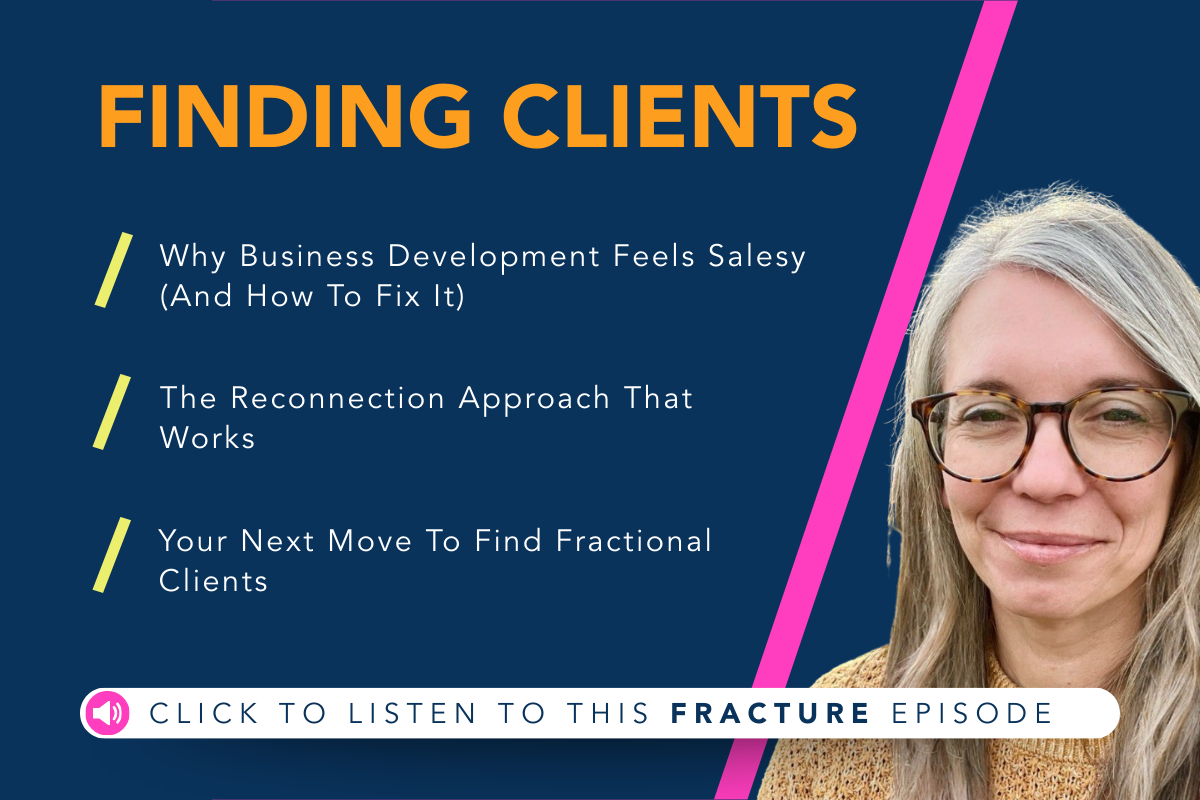
Click on the image to hear Nikki share how to Find Fractional Clients without feeling pushy, reconnect with your network in a genuine way, and make business development feel natural instead of salesy.
YOU DON'T NEED A WEBSITE TO FIND FRACTIONAL CLIENTS
Nikki admits she's a little embarrassed to share this: she just updated her LinkedIn with her website and company information.
Not when she started. Not when she got her first client. Not even when she got fully booked.
Recently. Almost a year into running her business.
Why now? Because she has a contract ending soon and needs to let people know she'll have space for new clients.
WHAT YOU NEED TO START
A website is like a digital business card. LinkedIn is the same. They don't hurt to have. But they're not critical to your success when you're starting out.
What Nikki needed was a place for people to book a call with her. That's basically what her website does.
The clients came from reconnecting with her network. Not from a fancy website. Not from a perfectly optimized LinkedIn profile.
From reaching out to people she'd worked with and letting them know what she was doing.
THE MINDSET SHIFT FROM "ASKING" TO "SUPPORTING"
I asked Nikki what the biggest shift in her thinking was around business development.
Here's what she said:
"I think just that reconnection with my network and it not being about 'what can you give me?' or 'how can you help me?' But like, how can we support each other?"
WHY REFRAMING CHANGES EVERYTHING
At first, Nikki thought reaching out would feel like asking for a handout.
Now she realizes: no, this is just how business works. You help each other.
"They will ask me for something one day and I'll help them out. It's just supporting each other. And particularly a lot of my network are women, so it also feels very like we're just empowering each other to reach higher."
This is what I see all the time: we're all here as consultants to help. We're helpers.
Not only do we want to help organizations, but we want to help the organizations we can't help because it's not how we serve them.
Someone's always asking me: "We're looking for someone who can do this. Do you know anyone?"
It's in our nature to want to make those connections and to serve when it's not in our wheelhouse.
WHAT YOU'RE DOING WHEN YOU REACH OUT
All you're doing when you reach out to your network is giving people the tools to help you.
You're not asking for handouts. You're letting them know what you're doing so they can connect you with opportunities when they arise.
It has nothing to do with you most of the time. It's about them wanting to be helpful and you making it easy for them to do that.
FRACTIONAL CONSULTING GIVES YOU GEOGRAPHIC FREEDOM
Here's something that proves the flexibility of the fractional model: Nikki's family is moving from the US to Canada.
Her spouse will be a full-time student. She'll be the breadwinner.
And her business? It comes with her.
She doesn't have to job hunt in a new country while settling in. She doesn't have to explain employment gaps or figure out how to translate her US experience to Canadian employers.
She has work booked. And it continues mostly uninterrupted.
HOW TO TELL CLIENTS ABOUT MAJOR LIFE CHANGES
Nikki told her clients about the move three months in advance, giving them plenty of time to plan around it.
She gave them the dates quickly so they could adjust schedules.
Both clients are educational nonprofits in early learning. Summer's pretty slow anyway. So taking a month off during the move wasn't a big deal.
Their response? "Good timing. Good for you. I wish we were going with you. Do you need an au pair? Can I come with you?"
Complete support.
One contract ends several months after the move. The other runs a few months longer. Natural transition points that work perfectly with the move and settling into a new country.
WHEN YOUR CLIENTS DON'T FIT THE PERFECT FRACTIONAL MODEL
Nikki's honest about something important: her current clients don't fit the typical fractional model.
With the interim Director of Development role, she's managing two staff members. She has set hours. She doesn't have the time freedom she's hoping to have eventually.
But that's okay.
There's the model, and then there's making the model work for you where you are and where your clients are.
BUILDING TOWARD THE MODEL YOU WANT
Nikki's excited for when one contract ends. She'll have space for a new client—hopefully a more "true" fractional client where she's meeting once a week and completing projects on her own time.
The flexibility she wants is coming. But she didn't wait for perfect fractional engagements before she started.
She started where the opportunities were. And she's building toward the model she wants.
That's what this is about: being helpful, balancing your own priorities, and playing around with what works for you.
THE QUESTIONS TO ASK IF BUSINESS DEVELOPMENT FEELS UNCOMFORTABLE
Stop Googling "how to find consulting clients without being pushy" and ask yourself these questions instead:
ARE YOU RECONNECTING OR ASKING FOR HANDOUTS?
There's a massive difference between "Can you give me a job?" and "I'm starting a business. If you hear of anyone who needs support, let me know."
One feels desperate. The other is just information.
Which one are you doing?
WHO ALREADY KNOWS YOUR WORK?
Nikki reached out to people she'd worked with years ago. Her "grand boss" from a previous nonprofit. Colleagues who knew her capabilities.
You don't need to convince strangers you're good at what you do. You need to reconnect with people who already know.
Who have you worked with in the past five or ten years who would vouch for your work?
ARE YOU WAITING FOR PERFECT BEFORE YOU START?
Nikki didn't have a website. She didn't have an updated LinkedIn. She got fully booked anyway.
You don't need perfect branding, a fancy website, or a LinkedIn strategy before you can start reaching out to your network.
You just need to let people know what you're doing.
WHAT'S THE WORST THAT HAPPENS?
Seriously. What's the worst-case scenario?
Someone says no? Someone doesn't respond? Someone thinks you're pushy?
Or someone says, "I have a client for you" a few weeks later.
The fear of what people will think is almost always bigger than the actual risk.
WHY YOU'RE AVOIDING OUTREACH
The real reason isn't that you don't know what to do. It's not that you don't have a website or a perfect LinkedIn.
It's that you're afraid of being visible. Of being vulnerable. Of people thinking you failed if you're starting a business.
But here's the thing: the people in your network want to help you. They're just waiting for you to tell them what you're doing and give them the chance to connect you with opportunities.
Business development isn't about being salesy. It's about reconnection.
And you don't need everything perfect before you start.
YOUR NEXT MOVE TO FIND FRACTIONAL CLIENTS
Stop waiting for the perfect moment or the perfect setup. Start with where you have relationships:
// Make a list of 10-15 people you've worked with in the past 5-10 years
// Reach out just to reconnect—coffee, phone call, or a simple email
// Mention you're thinking about starting a business (or that you have started)
// Don't ask for anything. Just let them know what you're doing
// Follow up a few months later when you're ready for clients
Your network wants to help you. You're not asking for handouts. You're giving them the opportunity to support you when they can.
That's not icky. That's just how business works.
Ready to find fractional clients without the pushy sales feeling?
// The Nonprofit Fractionals Operating System teaches you the exact business development approach that feels like reconnecting, not selling - plus how to close clients, set up your business, and manage fractional work without burning out. Join the waitlist here.
// In episode 15 of FRACTURE, we talked about how every boundary violation in your consulting business is on you, not your clients. The same applies to business development - if it feels icky, you're probably approaching it wrong. Read more about setting sustainable boundaries here.
// P.S. - Want to hear the full conversation with Nikki? She breaks down the exact emails she sent, how the coffee meeting turned into a client months later, and why moving countries with a fractional business is actually easier than job hunting. Listen here
Nikki is a fractional fundraising consultant supporting educational nonprofits. Connect with her on LinkedIn: https://www.linkedin.com/in/nikkirblack/

READY TO HEAR WHAT NO ONE ELSE IS SAYING?
Subscribe to Fracture. This private podcast is where we talk honestly about what it takes to build a fractional consulting business that pays you well, respects your time, and still lets you care deeply about your work.